DF Steel Pipe Successfully Delivers 12,000 Tons of API 5L X65 PSL2 LSAW Large-Diameter Steel Pipe with 3LPE Coating for Major Argentina Natural Gas Transmission Pipeline Project
Complete shipment of 30-inch longitudinal submerged arc welded line pipes with three-layer polyethylene anti-corrosion coating and internal epoxy flow efficiency lining arrived at Buenos Aires Port, Argentina, for one of South America's most significant natural gas infrastructure developments connecting the Vaca Muerta shale formation to northern demand centers. Full EN 10204 Type 3.1 certification, NACE MR0175/ISO 15156 sour service compliance, and Bureau Veritas third-party inspection coverage.
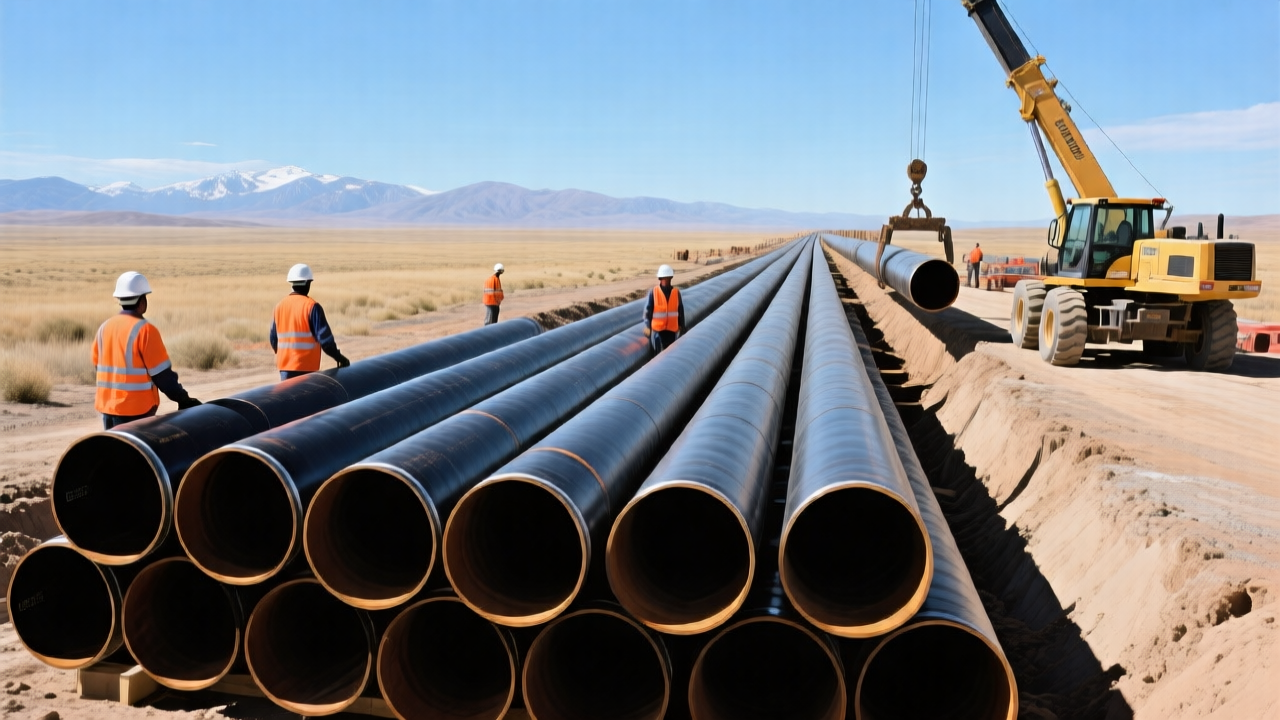
1. Project Background and Strategic Significance
The Argentina natural gas pipeline project represents one of the most critical energy infrastructure investments in South America in the past decade. Argentina possesses the world's second-largest shale gas reserves and fourth-largest shale oil reserves in the Vaca Muerta formation, located in the Neuquén Basin of Patagonia. The formation spans approximately 30,000 square kilometers and contains an estimated 308 trillion cubic feet of technically recoverable shale gas and 16.2 billion barrels of technically recoverable shale oil, according to the U.S. Energy Information Administration (EIA).
To unlock these vast hydrocarbon resources, Argentina requires a fundamental transformation of its natural gas transportation infrastructure. The existing pipeline network, largely constructed in the 1970s and 1980s, operates at insufficient capacity to evacuate growing Vaca Muerta production, which has increased from approximately 50 million cubic meters per day (MMcmd) in 2020 to over 130 MMcmd in early 2026. The pipeline project for which DF Steel Pipe supplied 12,000 tons of API 5L X65 LSAW pipes is an integral part of Argentina's Transport.Ar Gas Natural program, a multi-phase government-led initiative aimed at reversing the country's growing dependence on imported LNG and Bolivian gas imports.
The strategic significance of this pipeline extends beyond Argentina's borders. Upon completion, the expanded network could enable Argentina to export natural gas to Brazil, Chile, Uruguay, and potentially global LNG markets via liquefaction terminals on the Atlantic coast. This would transform Argentina from a net gas importer to a regional energy exporter, fundamentally reshaping the South American energy landscape. According to industry analysts, Argentina could achieve natural gas self-sufficiency by 2027 and generate USD $15-20 billion annually in gas exports by 2030.
For DF Steel Pipe, this order represents a landmark achievement in penetrating the Latin American large-diameter line pipe market. The EPC contractor selected DF Steel Pipe following a 12-month technical and commercial evaluation that assessed 14 international pipe manufacturers across criteria including API 5L compliance, coating capability, NDT testing infrastructure, on-time delivery track record, and commercial competitiveness. DF Steel Pipe's comprehensive quality management system and demonstrated ability to produce API 5L X65 PSL2 pipes with consistent mechanical properties across the entire 12,000-ton production run were decisive factors in the award.
2. Complete Technical Specifications
The 12,000-ton order comprised approximately 1,850 individual pipe joints manufactured to the following rigorous specifications, exceeding standard API 5L requirements in multiple critical parameters:
| Technical Parameter | Specification Detail |
|---|---|
| Product Type | LSAW (Longitudinal Submerged Arc Welded) Steel Pipe — JCOE forming process |
| Material Grade | API 5L X65 PSL2 (minimum yield strength 450 MPa / 65,000 psi) |
| Outer Diameter | 30 inches (762.0 mm) — tolerance ±0.5% per API 5L |
| Wall Thickness Range | 12.7 mm (0.500") for standard sections; 15.9 mm (0.625") for road/rail crossings and high-consequence areas |
| Pipe Length | Double Random Length — 11.8m to 12.5m (38.7 to 41.0 feet) |
| Steel Making Process | Fully killed, fine-grain practice, continuously cast slabs, controlled rolled and accelerated cooled (TMCP) steel plate |
| Chemical Composition | CE(IIW) ≤ 0.43%, Pcm ≤ 0.23% — optimized for excellent field weldability without preheat in ambient temperatures above 0°C |
| Tensile Properties | YS 485-605 MPa, UTS 565-745 MPa, Y/T ratio ≤ 0.92, elongation ≥ 22% (50mm gauge) |
| Charpy V-Notch Toughness | ≥ 120 J average / ≥ 90 J single at -20°C (pipe body transverse); ≥ 60 J average / ≥ 45 J single at -20°C (weld metal and HAZ) |
| DWTT (Drop Weight Tear Test) | ≥ 85% shear area at -10°C per API RP 5L3 — ensuring ductile fracture propagation resistance |
| Hardness | ≤ 250 HV10 (base metal, weld, HAZ) — NACE MR0175/ISO 15156 compliant for sour service |
| Weld Seam Inspection | 100% automated ultrasonic testing (AUT) with phased array probes (PAUT); 100% X-ray radiography (RT) on pipe end 300mm zones |
| Plate/Seam UT | 100% ultrasonic lamination check on steel plate per ASTM A578 Level C; 100% UT on full weld length |
| Hydrostatic Test | 95% SMYS minimum (exceeding API 5L's 90% SMYS requirement for X65); 15-second minimum hold time; 100% automated pressure recording |
| Dimensional Tolerances | OD: ±0.5% (3.8mm); WT: -5%/+10% of nominal; Straightness: ≤ 0.15% of length; Ovality: ≤ 1% of nominal OD |
| Pipe End Preparation | 30° bevel with 1.6mm ±0.8mm root face; end squareness ≤ 1.6mm measured across full diameter |
3. Advanced Coating System: 3LPE Technology
For this Argentina gas pipeline project, DF Steel Pipe applied one of the most advanced anti-corrosion coating systems available in the industry — Three-Layer Polyethylene (3LPE) external coating per DIN 30670, complemented by Internal Epoxy Flow Efficiency Lining. This dual-protection system ensures the pipeline's integrity for its full 50-year design life under demanding burial conditions across Argentina's diverse terrain, from the arid, rocky soils of Neuquén to the humid, clay-rich soils of the northern provinces.
3.1 Layer 1: Fusion Bonded Epoxy (FBE) Primer — 150-200 microns
The FBE primer is the foundation of the 3LPE system, applied as a dry powder via electrostatic spray onto grit-blasted pipe surfaces (Sa 2.5 cleanliness, Rz 50-90 microns anchor profile). The FBE layer provides excellent adhesion to steel (typically > 2,000 N/cm² pull-off strength) and outstanding cathodic disbondment (CD) resistance (< 6mm radius after 28 days at -1.5V, 65°C per CSA Z245.21). The FBE formulation was specifically selected for operating temperatures up to 80°C, accommodating the X65 grade's elevated temperature capability in compressor station discharge sections. Key quality control parameters for the FBE layer include: gel time 8-12 seconds at 230°C, cure time 25-35 seconds, porosity < 1% per cross-section microscopy, and 100% holiday detection at 5V/micron (minimum 750V for 150-micron thickness).
3.2 Layer 2: Copolymer Adhesive — 170-250 microns
The intermediate copolymer adhesive layer — a maleic anhydride-grafted polyethylene compound — creates a chemical and mechanical bridge between the polar FBE primer and the non-polar PE topcoat. Applied by side-wrap extrusion at 220-240°C melt temperature, the adhesive must achieve peel strength exceeding 50 N/cm at 23°C and 15 N/cm at 80°C per DIN 30670 Annex A testing. The adhesive thickness was optimized at 200 microns nominal to provide sufficient bond strength while maintaining the overall coating system thickness within design parameters.
3.3 Layer 3: High-Density Polyethylene (HDPE) Topcoat — 2.8-3.2 mm
The HDPE topcoat provides the mechanical protection essential for pipeline handling, transportation, trench backfill, and long-term buried service. Applied by spiral extrusion at 200-230°C, the PE layer was formulated with 2.5% carbon black for UV stabilization and specified to the following properties: density 0.945-0.955 g/cm³, melt flow index (MFI) 0.3-0.7 g/10 min, elongation at break ≥ 600% per ASTM D638, tensile strength ≥ 25 MPa, Vicat softening point ≥ 120°C, and dielectric strength ≥ 30 kV/mm. The minimum PE thickness of 2.8 mm was selected per DIN 30670 Table 2 for pipe OD 762 mm in mechanical protection Class B (normal burial conditions). For river crossing and road bore sections, PE thickness was increased to 3.5 mm for enhanced abrasion resistance.
3.4 Internal Epoxy Flow Coating — 65-80 microns DFT
All 1,850 pipe joints received internal epoxy flow efficiency coating per API RP 5L2 (non-corrosive gas service). The amine-cured epoxy was spray-applied in a single coat at 65-80 microns dry film thickness (DFT) using an automated rotating spray lance system. The internal coating provides: (a) reduced surface roughness — absolute roughness Rz ≤ 25 microns vs. 50-75 microns for bare steel, reducing friction factor by 25-35%; (b) improved flow efficiency — hydraulic efficiency gain of 3-8% enables either higher throughput or lower compression power; (c) corrosion protection during storage and hydrotesting — prevents atmospheric rust formation inside pipes before commissioning; (d) improved pigging efficiency — smoother internal surface allows more effective cleaning and intelligent pig inspection runs throughout the pipeline's operational life. 100% of pipe interiors were visually inspected using CCTV boroscope after coating, with DFT measurements taken at 12 circumferential positions per joint.
4. Comprehensive Quality Control and Inspection Protocol
The quality assurance program for this order exceeded standard API 5L Q1 and ISO 9001 requirements, incorporating additional testing and inspection hold points specified by the EPC contractor and witnessed by Bureau Veritas inspectors throughout the 14-week production campaign. The total number of individual inspection and test operations performed on this order exceeded 45,000, generating over 8,000 pages of quality records.
4.1 Raw Material Verification
All incoming steel plate was subjected to Positive Material Identification (PMI) using handheld X-Ray Fluorescence (XRF) analyzers calibrated to certified reference standards. Chemical composition was verified against the mill test certificate for every plate, with full optical emission spectrometry (OES) re-analysis performed on 5% of plates as a verification check. Ultrasonic lamination testing per ASTM A578 Level C was performed on 100% of the plate area, with any lamination indications exceeding 25mm in any dimension resulting in plate rejection. Charpy V-notch impact testing at -20°C was performed on each heat of steel, with a minimum of three specimens tested from each of two plates per heat, totaling six CVN tests per heat. Drop Weight Tear Test (DWTT) specimens were tested at -10°C per API RP 5L3, with two specimens per heat (one from each of two plates).
4.2 Manufacturing Process Control
During the JCOE forming process, each plate's edge crimping parameters, O-press force, and expansion ratio were electronically monitored and recorded with time-stamped data logging. The submerged arc welding (SAW) process parameters — including current (650-850A DC+), voltage (30-35V), travel speed (1,100-1,500 mm/min), wire feed rate, flux type and batch — were continuously monitored. SAW consumables (wire grade EM12K per AWS A5.17, agglomerated alkaline flux) were qualified through procedure qualification records (PQR) demonstrating the required tensile strength, CVN toughness, and hardness limits. For the internal (ID) weld pass, a two-wire tandem SAW system was employed; for the external (OD) weld pass, a three-wire tandem system with AC/DC/AC configuration ensured deep penetration and smooth bead profile. Mechanical expansion after welding applied 1.0-1.5% cold expansion to relieve residual welding stresses, achieve final dimensional tolerances, and verify weld integrity under strain.
4.3 Non-Destructive Testing (NDT) Program
The NDT inspection program represented approximately 30% of the total direct manufacturing labor cost per pipe — a deliberate investment reflecting the criticality of pipeline integrity for high-pressure gas transmission. UT inspection utilized a 32-channel Phased Array Ultrasonic Testing (PAUT) system with 5 MHz probes, achieving a detection sensitivity of 1.6mm flat-bottom hole equivalent. The system performed real-time B-scan, C-scan, and sector scan imaging, with all data digitally archived for the project's lifetime. X-ray radiography was performed using a 300 kV constant-potential X-ray tube with Digital Radiography (DR) flat panel detectors, providing real-time image analysis without chemical film processing. RT coverage was 100% on pipe ends (300mm at each end, exceeding API 5L's 200mm minimum) plus 100% on all weld seam intersections (stop-start locations) and weld repairs. Magnetic Particle Testing (MT) using fluorescent wet magnetic particles was performed on 100% of beveled pipe ends after final machining to detect any laminations, cracks, or surface-breaking defects. Additionally, 100% of the external weld reinforcement and all pipe surface areas were visually inspected under 500+ lux illumination per ASME B31.8 requirements.
4.4 Hydrostatic Pressure Testing
Every pipe in this order was individually hydrostatically tested at a minimum test pressure corresponding to 95% of the Specified Minimum Yield Strength (SMYS), which for 30" OD × 12.7mm WT X65 pipe calculates to approximately 24.8 MPa (3,600 psi). This exceeds the standard API 5L requirement of 90% SMYS for X65 grade. The pressure was maintained for a minimum of 15 seconds (vs. API 5L minimum of 10 seconds), with automated pressure recording at 100 Hz sampling rate to detect any pressure decay indicative of leakage. Post-hydrotest, 100% UT re-inspection of the weld seam was performed to detect any test-induced defect propagation. Pipes were also internally dewatered and dried within 4 hours of hydrotesting using high-velocity air drying to prevent internal corrosion.
5. Logistics, Shipping, and Export Documentation
The 12,000-ton cargo was shipped in six breakbulk vessel lots from Tianjin Xingang Port to Buenos Aires Terminal 5 (Terminales Río de la Plata), spanning 8 weeks of loading operations. Each vessel carried approximately 2,000 tons of pipe — equivalent to 300-320 joints per vessel. DF Steel Pipe's logistics team coordinated all aspects of the export operation, including port booking, customs clearance, fumigation, and shipping documentation. Pipes were loaded using 40-ton capacity spreader bars with nylon slings to prevent coating damage, with each layer separated by timber dunnage. Before vessel departure, Bureau Veritas marine surveyors verified cargo securing arrangements and coating integrity, issuing Clean on Board Bills of Lading for each lot. All six vessel lots arrived at Buenos Aires within 38-42 days via the Cape of Good Hope route, and DF Steel Pipe achieved zero cargo damage claims — every pipe arrived at the job site ready for stringing and welding without requiring field coating repair.
6. Argentina Natural Gas Market Analysis and Pipeline Infrastructure Outlook
Argentina's natural gas sector is undergoing a profound transformation driven by Vaca Muerta's accelerating production growth. Current natural gas production of approximately 130 MMcmd is projected by Argentina's Energy Secretariat to reach 200-250 MMcmd by 2030, of which an estimated 30-50 MMcmd could be available for export. The Néstor Kirchner Gas Pipeline (former President Néstor Kirchner Gas Pipeline — GPNK), inaugurated in July 2023, was the first phase of Argentina's gas infrastructure expansion plan. Future pipeline phases — including the Perito Francisco Pascasio Moreno pipeline (formerly San Martín pipeline) and the reversal of northern pipelines — require an estimated 3,500-5,000 kilometers of new large-diameter trunklines and associated gathering systems over the next 7-10 years. According to industry association CEPA (Cámara de Empresas Productoras de Energía), total pipeline infrastructure investment in Argentina is projected at USD $5-7 billion through 2032. This massive infrastructure buildout positions Argentina as one of the fastest-growing markets globally for API 5L large-diameter line pipe, pipeline coatings, fittings, flanges, and associated pipeline components.
For DF Steel Pipe, the successful execution of this 12,000-ton order establishes a critical reference for future Argentine and broader Latin American pipeline projects. The ability to deliver X65 grade LSAW pipes with advanced 3LPE coating, comprehensive MTC documentation, BV third-party inspection, and on-schedule delivery provides a compelling value proposition for EPC contractors and end-users across the region. DF Steel Pipe continues to actively pursue pipeline opportunities in Peru, Mexico, Brazil, Chile, and Colombia, leveraging this Argentine project as a best-in-class technical and commercial reference.
7. Frequently Asked Questions — LSAW Line Pipe for Gas Pipelines
Q: What distinguishes API 5L X65 PSL2 from PSL1 line pipe?
PSL2 (Product Specification Level 2) imposes mandatory requirements beyond PSL1, including: maximum carbon equivalent (CE) limits for weldability; mandatory Charpy V-notch impact testing at specified temperatures; maximum yield-to-tensile ratio of 0.93 for X65; mandatory NDT of the weld seam (UT or RT); and traceability requirements linking each pipe to its heat number and test records. PSL2 is specified for high-pressure, high-consequence pipelines where the consequences of failure warrant enhanced quality assurance beyond the basic PSL1 requirements.
Q: Why use LSAW pipe instead of SSAW spiral pipe for gas transmission?
LSAW pipes provide superior dimensional accuracy (tighter OD and straightness tolerances) and shorter weld seam length per meter compared to SSAW, resulting in fewer potential defects per joint. For high-pressure gas pipelines (≥ 6 MPa), LSAW is generally preferred because the simple longitudinal weld geometry enables more reliable automated UT inspection compared to the helical weld pattern of SSAW. Additionally, LSAW's JCOE manufacturing process can accommodate thicker walls (up to 65mm) and higher steel grades than most SSAW mills.
Q: How does 3LPE coating compare to FBE-only coating for buried pipelines?
3LPE provides three distinct advantages over single-layer FBE: (1) Mechanical protection — the PE topcoat absorbs and distributes impact energy during handling, lowering, and backfill; (2) Lower moisture permeation — PE has water vapor transmission rate approximately 1/50th of FBE at equivalent thickness; (3) Higher operating temperature capability — 3LPE systems typically handle sustained operating temperatures up to 80°C vs. 65°C for standard FBE. The trade-off is higher material cost (approximately 15-25% premium over FBE), which is justified for large-diameter, high-pressure pipelines with 50+ year design lives.
Need LSAW Line Pipe for Your Pipeline Project?
Contact our engineering team for technical proposals and competitive quotations. API 5L X42-X80, OD 16"-72", 3LPE/3LPP/FBE coating available. 24-hour response.
✉ Request Quote 💬 WhatsApp